
Do I need a separate R-410A or EPA A2L certification?
A common question on HVAC forums is whether a new refrigerant makes an old 608 card unusable. Another is whether a course advertised as “R-410A certification” can substitute for 608. The answer becomes clearer when you separate the federal technician credential, the course's learning goals, and the instructions for the equipment you will actually encounter.
EPA certification follows appliance categories
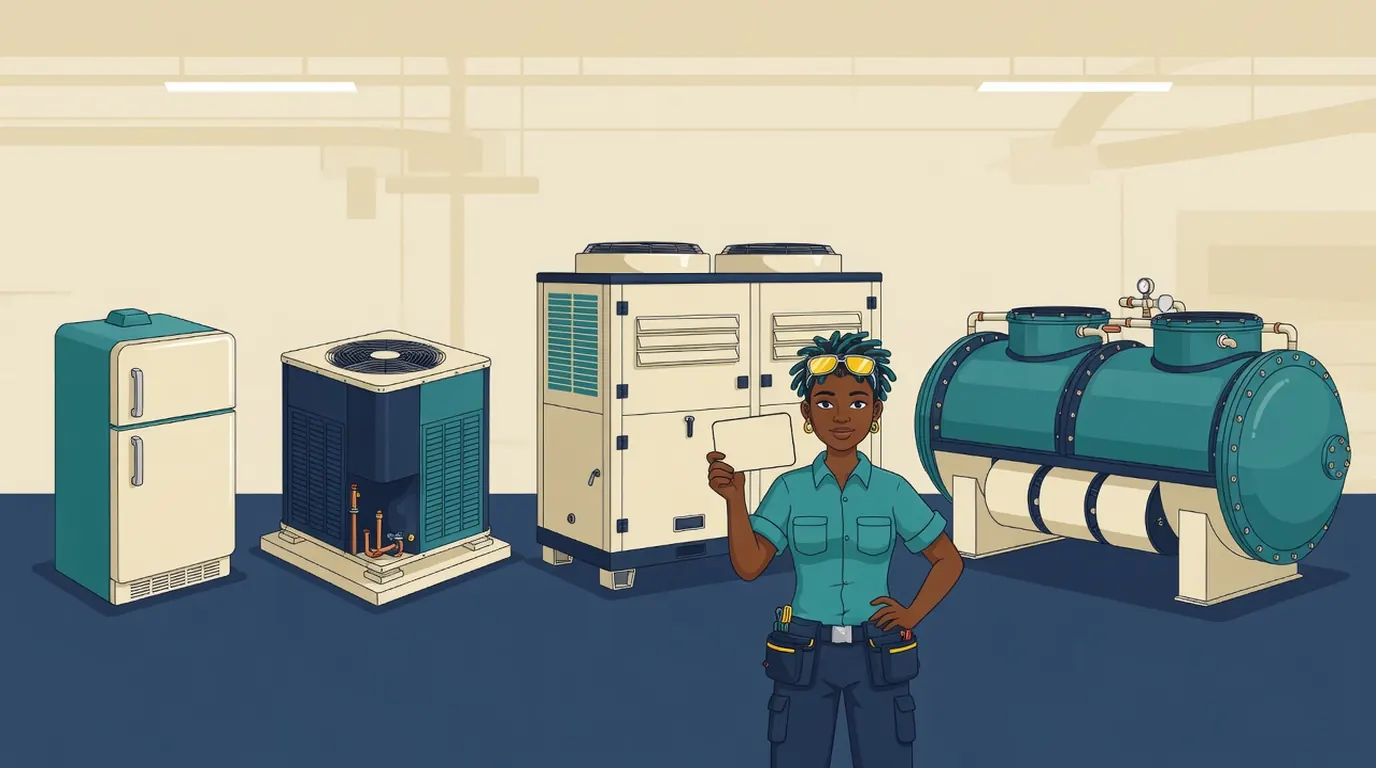
Section 82.161 organizes certification around appliance categories and applies to ozone-depleting refrigerants and non-exempt substitute refrigerants. The credential names are Type I, Type II, Type III, and Universal. They are not a list of individual refrigerant brands or refrigerant numbers.
EPA's technician Q&A directly addresses R-410A: it does not have a certification devoted exclusively to that refrigerant, and trade-school R-410A certificates are not equivalent to Section 608 certification. That is the most useful source to show someone who asks for “the EPA 410A card.”
Check your existing type against the appliance you intend to service. A refrigerant change is not a reason to ignore the equipment category, and a refrigerant-specific course does not expand Type I into Type II. Our Type II versus Universal guide walks through that decision.
What the HFC recertification answer establishes
In its HFC program FAQ, EPA answers the question of whether already-certified Section 608 or 609 technicians need to be recertified with a clear no. Read that answer in context: it concerns those existing credentials under the HFC program. It is not a promise that every workplace, manufacturer, or jurisdiction has identical training expectations.
This is why “I need A2L training” and “EPA requires me to retake 608” should not be treated as the same statement. Ask which credential or course is being requested and who requires it. A precise name and source are more useful than arguing about whether the word “certification” appears on the completion document.
Our AIM Act guide explains the broader HFC context. For the credential question, keep the evidence narrow: use EPA's recertification answer and its appliance-based certification categories. Avoid turning a changing product market into an invented federal renewal deadline.
A course can be useful without being a new EPA card
A training course may teach material relevant to a particular refrigerant family, product line, or work assignment. Evaluate it by what you need to learn. A course outline, demonstration of the equipment covered, and explanation of how learning is assessed tell you more than a badge graphic.
Ask the provider what document you receive and what that document represents. Is it a record of course completion, a manufacturer training result, or an EPA Section 608 credential issued after an approved exam? These documents can serve different purposes. Keep their names distinct in your records.
EPA says it does not review or approve preparatory training programs or materials. An organization appearing on the EPA testing list is approved to administer certification testing; that listing does not make every video, optional module, or separate certificate an EPA-approved course.
When comparing classes, write down the topics, intended audience, practical exercises, instructor support, and prerequisites. Then compare that outline with your assignment. A course that answers a real knowledge gap may be worthwhile without changing the scope of your federal certification.
Tools and technician credentials answer different questions
A machine's suitability for a refrigerant is not established by the technician's card. Section 82.154 addresses recovery or recycling equipment certified for the refrigerant and appliance, and Section 82.156 addresses using that equipment according to manufacturer directions unless those directions conflict with the regulation.
That means you should examine the equipment documentation on its own terms. Find the exact model, intended refrigerants, instructions, and limitations. Do not infer suitability from a similar-looking tool or from a course certificate held by its operator.
This article does not assign an A2L rating to any recovery machine or vacuum pump. Such a claim needs the actual product documentation and applicable requirements. Keep a tool-selection question separate from “does my 608 expire?” so that answering the easy credential question does not prematurely close the equipment question.
How to evaluate a request for another certificate
Suppose an employer asks you to complete an A2L course before working on a new product line. Ask for the course name, required completion evidence, and the equipment or tasks it prepares you for. That lets you meet the request without mistakenly describing the result as a replacement EPA credential.
Suppose instead that an advertisement says your old 608 is no longer valid unless you buy an upgrade. Ask for the current EPA or regulatory source supporting that statement. Compare it with the official non-expiration and recertification guidance. Marketing language alone is not evidence that federal certification categories have changed.
Finally, suppose you have a refrigerant-specific class certificate but never passed an approved 608 exam. Locate the issuing organization and inspect the document. Does it actually identify a Section 608 type? If it only records course completion, use our exam overview to plan the certification route separately.
These examples share a practical habit: name the requirement before buying the solution. You can then decide whether the next step is an exam, a course, an employer conversation, or a review of equipment instructions.
Common myths
Myth “An R-410A course certificate is automatically 608.”
Fact EPA expressly distinguishes the two.
Myth “The HFC program makes existing technicians retake 608.”
Fact EPA's FAQ says existing 608 and 609 technicians do not need recertification.
Myth “No new EPA card means no further learning.”
Fact The credential does not answer every equipment-specific training question.
Myth “Universal certifies my tools too.”
Fact Technician scope and equipment suitability must be checked separately.
Keep the official credential, course records, and relevant equipment documents easy to identify. Our EPA resources can help you return to the source when a new claim circulates, without confusing a useful training opportunity with a federal rule.
Study disclaimer: This is exam-study material, not legal advice or field-service instructions. Consult the linked EPA and eCFR sources for current requirements.
Sources
- EPA: R-410A certification and technician questions
- EPA: HFC program FAQ, including technician recertification
- 40 CFR 82.161: appliance-based technician certification
- EPA: Section 608 certification types
- 40 CFR 82.154: covered refrigerants and equipment requirements
- 40 CFR 82.156: use of recovery equipment
- EPA: certification programs and limits of training approval
Check yourself
Which listed ASHRAE safety group denotes lower toxicity and lower flammability with a low burning velocity?
Show answer
Answer: B. A2L
A2L combines toxicity class A with flammability subclass 2L. It does not mean nonflammable or harmless. Source: ASHRAE Standard 34 safety classifications.
Which of the following refrigerants is an HFO?
Show answer
Answer: D. R-1234ze
R-1234ze is an HFO refrigerant. R-22 is an HCFC, while R-134a and R-410A are HFC refrigerants.
The venting prohibition under Section 608 applies to:
Show answer
Answer: C. CFCs, HCFCs, and non-exempt substitutes, including HFCs.
The prohibition covers ozone-depleting refrigerants and non-exempt substitutes during maintenance, service, repair, or disposal. The statutory substitute prohibition took effect in 1995; it was not first created by the 2016 equipment-management rule. Source: 40 CFR 82.154(a).
Practice this
Test the appliance-category foundation with the free Type II practice test. Use manufacturer and course materials separately for equipment-specific training.
Take the Type II practice testRead next
EPA 608 Type II vs Universal: which type do you need?
Choose an EPA 608 certification by the equipment you will service, understand what Universal adds, and plan the right exam sections.
EPA 608 vs 609: which certification do you need?
Compare EPA 608 and 609 for stationary equipment, vehicle air conditioning, MVAC-like appliances, and refrigerant purchases.